


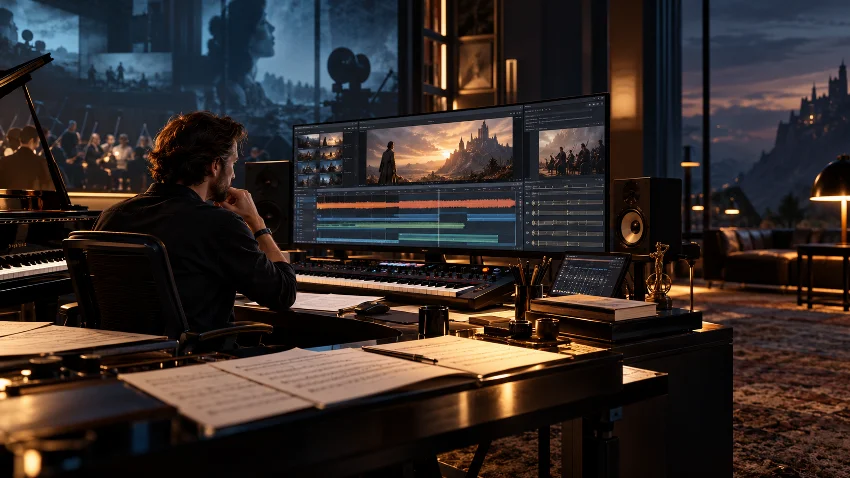
Imagine watching your favourite movie without its iconic soundtrack, dramatic sound effects, or carefully crafted background music. Even the most visually stunning scenes would feel completely different without sound guiding the emotional experience.
The relationship between Music and Film has evolved into a sophisticated creative industry where composers, directors, sound designers, and producers collaborate to build unforgettable cinematic experiences. From orchestral scores to immersive audio technology, sound influences how audiences interpret stories and connect with characters.
This comprehensive guide explores advanced techniques, production workflows, commercial strategies, and emerging technologies shaping modern cinema and audiovisual entertainment.
1. Understanding the Relationship Between Music and Cinematic Storytelling
Cinema combines visual imagery, dialogue, movement, and sound to communicate stories. Although audiences often concentrate on what appears on screen, audio plays an equally important role in shaping emotional responses.
A carefully designed soundtrack can communicate tension, excitement, nostalgia, or uncertainty without requiring additional dialogue.
How Music Influences Audience Emotions
Film composers use melody, harmony, rhythm, instrumentation, and dynamics to influence how viewers experience a scene.
Consider a character walking alone through an unfamiliar building. Gentle piano music might suggest sadness or reflection, while low-frequency electronic textures could transform the same visuals into a suspenseful sequence.
The images remain unchanged, but the emotional interpretation becomes completely different.
Berklee Online explains that cinematic composition involves translating dramatic meaning into musical expression.
Composers must understand character motivations and narrative developments before determining which musical techniques best support the story.
This process requires more than selecting attractive melodies.
The most effective scores reinforce emotional meaning without overwhelming the visual narrative.
Understanding Diegetic and Non-Diegetic Sound
Film sound is commonly divided into diegetic and non-diegetic elements.
Diegetic sound originates within the fictional world of the story. Examples include conversations, footsteps, traffic, and music playing from a radio that characters can hear.
Non-diegetic sound exists primarily for the audience.
An orchestral score accompanying a dramatic confrontation is a common example.
However, filmmakers sometimes blur the distinction between these categories.
A song might begin playing from a character’s headphones before expanding into a full cinematic soundtrack.
This transition can connect a character’s personal experience with the audience’s emotional perspective.
Using Silence as a Storytelling Technique
Silence can be just as expressive as music.
Removing background sound during a dramatic moment may create discomfort, anticipation, or emotional intimacy.
A sudden reduction in audio complexity can direct attention towards a character’s expression or an important visual detail.
However, effective silence rarely means completely eliminating every sound.
Subtle breathing, room tone, or environmental noise may remain to maintain realism.
The creative challenge involves understanding when sound strengthens a scene and when restraint produces a more meaningful result.
2. Advanced Film Scoring and Cinematic Music Composition
Film scoring combines traditional musical composition with the timing and storytelling requirements of moving images.
Unlike independent songwriting, cinematic music must respond to scene duration, dialogue placement, editing patterns, and dramatic structure.
This requires both musical creativity and technical precision.
Developing Themes and Leitmotifs
A leitmotif is a recurring musical idea associated with a character, location, emotion, or narrative concept.
It can evolve throughout a film as the story develops.
John Williams’ work on the Star Wars films offers well-known examples of recurring musical themes that help establish character identity and emotional continuity.
A theme may initially appear through a simple instrumental arrangement before returning later with expanded orchestration.
This musical transformation can suggest character growth or changes in dramatic circumstances.
Composers can create similar effects through variations in harmony, tempo, instrumentation, or rhythmic structure.
The objective is to make musical repetition meaningful rather than predictable.
Synchronising Music With Visual Editing
One of the central challenges in film scoring is aligning musical development with visual events.
Composers may need to emphasise important actions, emotional revelations, or transitions between scenes.
These moments are sometimes called synchronization points or hit points.
For example, a dramatic chord could coincide with the moment a character discovers an important secret.
However, synchronising every visible movement can make a soundtrack feel exaggerated.
Experienced composers select moments that genuinely benefit from musical emphasis.
Tempo mapping and digital audio workstations help align musical structures with picture timing.
These tools allow composers to adjust arrangements while maintaining precise synchronization.
Choosing Between Orchestral and Electronic Scores
Traditional orchestral arrangements remain popular in cinema because acoustic instruments offer extensive expressive possibilities.
Strings can communicate emotional warmth, brass instruments can create intensity, and woodwinds can introduce delicate tonal colours.
Electronic composition provides different creative opportunities.
Synthesizers, sampling, and digital sound manipulation allow composers to construct textures that may be difficult to reproduce acoustically.
Many contemporary film scores combine both approaches.
A science fiction soundtrack, for example, might use orchestral strings alongside processed electronic pulses.
The ideal instrumentation depends on the film’s artistic direction rather than assumptions about which musical style sounds more expensive or cinematic.
3. Mastering Professional Sound Design and Audio Post-Production
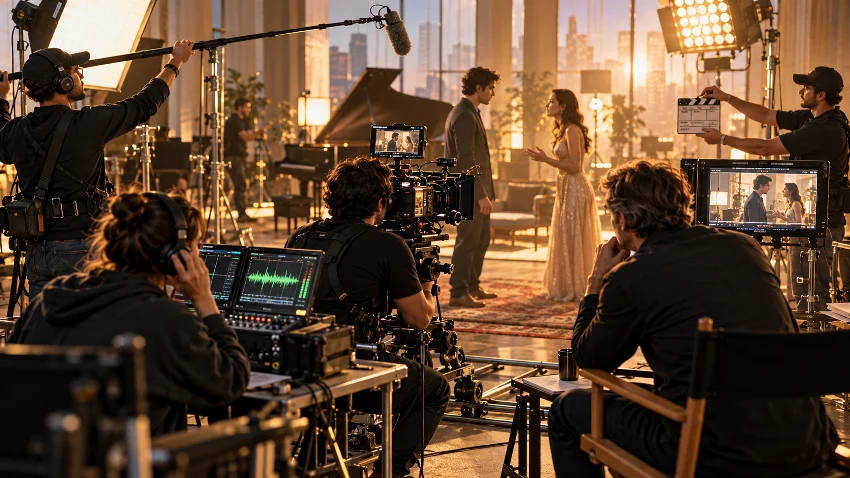
Sound design involves creating, selecting, recording, and manipulating audio elements that support the cinematic environment.
It extends beyond obvious effects such as explosions or footsteps.
A convincing soundtrack may contain hundreds of carefully balanced layers.
Creating Realistic Sound Environments
Sound designers construct environments using recorded sounds, synthetic elements, and specialised editing techniques.
A crowded railway station might include distant conversations, mechanical vibrations, announcements, footsteps, and passing vehicles.
Each layer contributes to the sense of location.
However, realism does not always require reproducing every sound that would exist in real life.
Sound designers frequently simplify complex environments to direct audience attention.
An important conversation might require reducing background activity while preserving enough detail to maintain the atmosphere.
The British Film Institute’s Sound Design & Mixing Handbook introduces the production concepts and workflows used to develop cinematic soundscapes.
These techniques demonstrate how audio can support storytelling rather than function as an afterthought.
Understanding Foley and Sound Effects
Foley refers to sound effects performed and recorded in synchronisation with moving images.
Artists may recreate footsteps, clothing movement, object handling, and other physical interactions.
For example, a character walking across a wooden floor might require specially recorded footsteps that match the actor’s timing and movement.
Foley provides greater control over sound quality and dramatic emphasis.
It can also restore details that were difficult to capture during filming.
Other effects may come from location recordings, licensed sound libraries, or electronically generated sources.
Professional sound editors combine these materials into a convincing and coherent audio environment.
Balancing Dialogue, Music and Effects
The final soundtrack must balance different audio categories.
Dialogue usually requires particular attention because audiences need to understand important narrative information.
Music and effects should complement spoken performances rather than compete with them.
During a dramatic action sequence, the sound mix might emphasise impact effects while reducing some musical frequencies.
In a quiet conversation, subtle environmental sounds may create realism without distracting from the actors.
Re-recording mixers adjust levels, frequency balance, spatial placement, and dynamic range.
The final mix must also work across intended distribution formats, from cinemas to home entertainment systems.
4. Exploring Immersive Audio and Modern Cinema Technology
Audio technology has changed significantly since the introduction of synchronised sound in commercial cinema.
Modern production tools provide increasingly detailed control over spatial positioning, acoustic environments, and sound reproduction.
These developments create new creative possibilities for filmmakers.
Understanding Dolby Atmos and Spatial Audio
Dolby Atmos is an immersive audio technology that allows sound creators to work with audio objects and spatial positioning.
Rather than relying exclusively on conventional channel-based arrangements, compatible Atmos workflows can position and move sounds within a three-dimensional listening environment.
For example, a helicopter passing overhead may be represented through spatial audio movement.
Environmental effects can also create a stronger sense of surrounding space.
Dolby explains that Atmos experiences adapt to supported playback equipment and listening environments.
However, results depend on the content, compatible devices, acoustic conditions, and playback configuration.
Immersive technology does not automatically improve storytelling.
Its value comes from supporting the intended cinematic experience.
Advances in Digital Audio Workstations
Digital Audio Workstations, commonly called DAWs, are central tools in modern sound production.
Professional applications allow composers and engineers to record, edit, arrange, process, and mix complex audio projects.
Film composers often work with virtual instruments, orchestral sample libraries, synthesizers, and synchronised video playback.
Sound editors may manage large collections of dialogue, effects, and environmental recordings.
These workflows require careful organisation.
Clear track naming, version management, and consistent project structures make collaboration more efficient.
When multiple specialists work on the same production, technical consistency becomes particulary important.
Artificial Intelligence in Audio Production
Artificial intelligence is increasingly used in certain audio-production workflows.
Possible applications include dialogue enhancement, noise reduction, audio classification, and assistance with editing repetitive tasks.
For example, a production team might use an audio restoration tool to reduce unwanted background noise in a recorded interview.
However, automated processing can introduce audible artifacts or alter important acoustic details.
Human review remains necessary.
AI-generated musical content also raises questions about authorship, consent, licensing, and the use of copyrighted material.
Studios should evaluate applicable legal requirements before incorporating generated audio into commercial productions.
5. Managing Film Music Production and Creative Collaboration
Producing a successful soundtrack requires coordination between several creative and technical professionals.
Directors, composers, music editors, sound designers, producers, and re-recording mixers contribute different expertise.
Communication can determine whether these contributions become a cohesive cinematic experience.
Building Effective Director-Composer Relationships
Directors often describe musical requirements using emotional language rather than technical terminology.
They might request something mysterious, hopeful, uncomfortable, or emotionally restrained.
Composers translate these descriptions into musical decisions.
Sundance Institute’s discussions with filmmakers and composers highlight the importance of shared creative understanding.
Early conversations should address story themes, character development, musical references, and the intended audience experience.
Rather than discussing only individual scenes, collaborators benefit from understanding the film’s overall emotional structure.
This creates a clearer foundation for composition.
Understanding Spotting Sessions
A spotting session is a collaborative review in which filmmakers and audio professionals identify where music should begin, end, or change.
Participants also discuss scenes that may work better without musical accompaniment.
These sessions help establish creative priorities before detailed composition begins.
For example, a director might initially expect continuous music throughout an emotional sequence.
After reviewing the scene, the team could decide that a short musical passage followed by silence would create a stronger effect.
Spotting sessions help prevent unnecessary composition and reduce later revisions.
They also allow composers to understand how music will interact with dialogue and sound effects.
Managing Budgets and Production Schedules
Film music budgets vary significantly depending on project size, instrumentation, recording requirements, and licensing arrangements.
An independent documentary may rely on a small ensemble and electronic production.
A major studio film might involve orchestral recording sessions, specialised studios, music editors, and extensive mixing work.
Budget planning should account for creative fees, recording expenses, performers, technical support, and rights clearance.
Production schedules also require flexibility.
Changes to picture editing can affect musical timing and necessitate revisions.
Clear communication and realistic deadlines help reduce expensive last-minute complications.
6. Understanding Music Licensing and Copyright in Cinema
Music rights are essential considerations in audiovisual production.
Using a song in a film generally involves legal permissions that differ from those required for ordinary personal listening.
These requirements can influence creative decisions, budgets, and distribution opportunities.
Synchronisation and Master Recording Rights
When filmmakers want to include an existing commercial recording, they commonly need permission relating to both the musical composition and the specific sound recording.
A synchronisation licence generally addresses use of the underlying musical work with visual images.
A master-use licence addresses use of a particular recorded performance.
These rights may belong to different parties.
The World Intellectual Property Organization explains that filmmakers must identify the rights required for their intended uses and negotiate with relevant owners.
For example, licensing a popular song for a feature film may involve different terms from using the same recording in an international advertising campaign.
Distribution territories, duration, platforms, and promotional uses can affect the agreement.
Original Scores and Ownership Agreements
Commissioning an original score may simplify some clearance issues, but ownership still requires careful attention.
Contracts should define who owns the composition, sound recording, and associated usage rights.
Agreements may also address royalties, credits, soundtrack releases, and permitted adaptations.
These details become especially important when a film is later distributed internationally.
A composer may retain certain rights even when a producer receives broad permission to use the music.
The precise arrangement depends on contracts and applicable copyright law.
Independent filmmakers should avoid assuming that paying a composition fee automatically transfers every relevant right.
Planning Music Rights Before Distribution
Music clearance should begin early in production.
Waiting until distribution negotiations are underway can create expensive problems.
A song included in a temporary edit may become difficult to replace once the entire sequence has been structured around it.
Producers should document musical sources and maintain accurate licensing records.
They should also confirm whether permissions cover cinema exhibition, streaming platforms, television, promotional trailers, and other intended uses.
Early planning provides greater creative and financial flexibility.
7. Analysing the Business of Film Soundtracks and Digital Music
The commercial relationship between cinema and recorded music extends beyond the film itself.
Soundtracks can introduce audiences to artists, expand cultural visibility, and create additional licensing opportunities.
However, the financial structure varies between original scores, licensed songs, and separately released soundtrack albums.
Streaming and the Recorded Music Economy
The International Federation of the Phonographic Industry reported that global recorded music revenues reached US$31.7 billion in 2025.
This represented annual growth of 6.4%.
Streaming remained a major driver, accounting for 69.6% of worldwide recorded music revenue when subscription and advertising-supported formats were combined.
These figures demonstrate the continuing commercial importance of digital music distribution.
For film soundtracks, streaming platforms provide opportunities for listeners to discover compositions outside the cinema.
However, streaming revenue does not necessarily flow directly to composers or performers.
Payments depend on contracts, ownership structures, distribution arrangements, and applicable royalty systems.
Soundtracks as Cultural and Commercial Assets
A successful soundtrack can extend the emotional identity of a film beyond its theatrical release.
Audiences may associate particular musical themes with characters, memorable scenes, or an entire cinematic franchise.
For example, the scores of Interstellar, The Lord of the Rings, and The Dark Knight have developed recognition beyond their original viewing contexts.
Concert performances, soundtrack recordings, and online listening can introduce the music to new audiences.
Nevertheless, not every film benefits commercially from a separate soundtrack release.
The opportunity depends on audience interest, musical identity, distribution agreements, and production costs.
Measuring Soundtrack Performance
Soundtrack performance can be evaluated through several indicators.
Streaming activity, album sales, licensing income, audience engagement, and cultural recognition may all provide useful information.
However, financial returns should be interpreted alongside ownership and contractual arrangements.
A heavily streamed soundtrack is not automatically profitable for every participant.
Production expenses, distribution fees, royalty structures, and marketing costs influence economic outcomes.
An effective commercial strategy considers both artistic value and realistic financial expectations.
8. Exploring Iconic Film Scores and Their Creative Techniques
Studying established film scores helps reveal how musical ideas interact with visual storytelling.
Different composers use distinctive approaches to melody, harmony, rhythm, and sonic texture.
Examining these methods offers practical lessons for filmmakers and music enthusiasts.
John Williams and Thematic Storytelling
John Williams is widely recognised for his work on films such as Star Wars, Jaws, and Jurassic Park.
His orchestral writing frequently uses memorable themes to establish emotional identity.
In Jaws, the recurring musical figure creates tension through repetition and gradual intensification.
The effectiveness of the motif comes partly from its simplicity.
It demonstrates how a carefully designed musical idea can become closely associated with a dramatic concept.
For aspiring composers, the lesson is that complexity is not always necessary.
A distinctive theme can be more powerful than an elaborate arrangement.
Hans Zimmer and Hybrid Sound Design
Hans Zimmer’s work often combines orchestral instrumentation with electronic processing and distinctive rhythmic textures.
Films such as Inception and Interstellar illustrate different approaches to building cinematic intensity.
In Interstellar, organ-based textures contribute to the score’s distinctive emotional and spatial character.
The music frequently emphasises atmosphere and sustained development rather than relying exclusively on conventional action scoring.
Hybrid composition creates opportunities to integrate musical and sound-design elements.
However, large sonic textures require careful mixing to preserve clarity and avoid overwhelming dialogue.
Contemporary Experimental Scoring
Experimental film music often challenges conventional expectations.
Instead of relying on familiar orchestral themes, composers may use unusual instruments, fragmented rhythms, unconventional harmonies, and processed sounds.
The film Everything Everywhere All at Once provides an example of close collaboration between filmmakers, composers, and sound designers.
Sundance Institute documented how the directors and Son Lux worked with audio specialists to help shape the film’s distinctive cinematic world.
Such approaches demonstrate that the boundary between music and sound effects can be creatively flexible.
A sound may function simultaneously as environmental detail, rhythmic material, and emotional expression.
This flexibility is particularly valuable in films exploring unusual narrative structures.
9. Preparing for the Future of Cinema and Sound Production
The relationship between music and visual storytelling continues to change.
Streaming distribution, immersive audio, artificial intelligence, and remote collaboration are influencing how audiovisual projects are produced.
However, technological innovation remains most valuable when it supports meaningful creative decisions.
Remote Collaboration and Cloud Production
Modern production teams may work across different countries and time zones.
Cloud-based file sharing, collaborative project management, and remote review systems can help coordinate complex workflows.
A composer might develop material in one country while the director reviews edits elsewhere.
These arrangements create flexibility but require disciplined version management.
Teams should establish clear file naming, technical standards, and approval procedures.
Reliable communication reduces the risk of working with outdated edits or incorrect audio materials.
Growing Opportunities for Independent Creators
Affordable recording technology and digital distribution platforms have expanded opportunities for independent filmmakers and composers.
Professional-quality production no longer always requires access to extremely expensive facilities.
However, accessibility also increases competition.
Creators need distinctive skills, reliable working practices, and strong professional relationships.
A musician interested in film composition might build experience through short films, documentaries, student productions, and collaborative projects.
A carefully organised portfolio can demonstrate creative versatility and technical competence.
Balancing Innovation With Artistic Identity
New production tools will continue to influence cinematic sound.
However, the quality of a soundtrack ultimately depends on how effectively it serves the story.
Technology can expand creative possibilities, but it cannot replace thoughtful narrative interpretation.
Filmmakers should evaluate whether a new technique adds genuine emotional or artistic value.
A restrained piano theme may be more effective than a complex immersive arrangement when the story calls for intimacy.
The most succesful creative approach combines technical knowledge, experimentation, and clear storytelling intentions.
The Music and Film industry thrives on the powerful connection between visual storytelling, musical composition, and sound design. From traditional orchestral scoring to immersive audio technology, every creative decision can influence how audiences experience cinema.
Explore different scoring techniques, study professional production workflows, and develop a deeper understanding of music rights and distribution. Whether you’re a filmmaker, composer, or enthusiast, start discovering how thoughtful sound transforms ordinary scenes into unforgettable cinematic experiences.
Editorial Note: This article is intended for educational and informational purposes. Music licensing rules, copyright ownership, and distribution requirements vary across jurisdictions and contractual arrangements. Consult qualified legal professionals when negotiating commercial audiovisual rights.