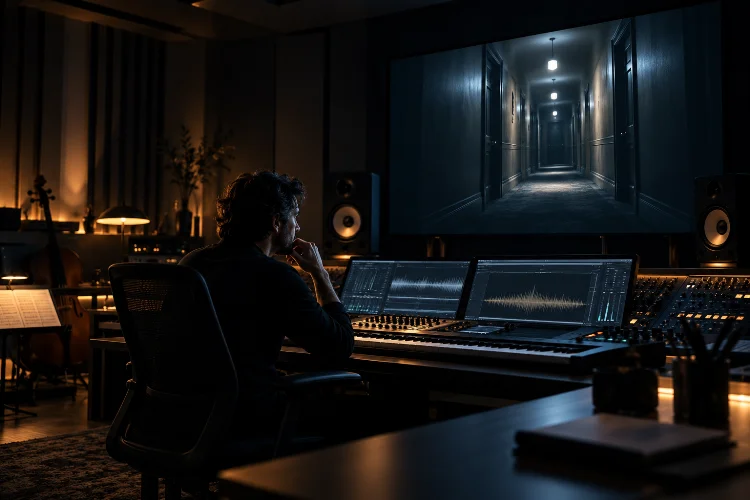
Imagine watching a character slowly walk through an empty hallway. Nothing unusual happens. The lights stay on, the doors remain closed, and there’s no visible danger. Yet somehow, you’re gripping your seat, expecting something terrifying to appear.
What’s making you nervous?
Chances are, the music has something to do with it.
Original film scores possess an extraordinary ability to influence how audiences interpret ordinary scenes. A low musical drone can make an empty room feel threatening, while a sudden burst of strings can transform a harmless movement into a moment of panic.
The most effective suspense music doesn’t simply announce danger. It creates anticipation, uncertainty, and emotional discomfort before anything frightening occurs.
Understanding how original film scores build psychological tension and suspense reveals the creative techniques composers use to influence cinematic experiences.
From Bernard Herrmann’s piercing strings in Psycho to Hildur Guðnadóttir’s haunting cello compositions in Joker, film music has evolved into a sophisticated form of emotional storytelling.
Let’s explore the musical techniques behind psychological suspense, examine influential examples, and discover why some of cinema’s most terrifying moments begin with what we hear rather than what we see.
Why Film Music Has Such a Powerful Psychological Effect
Film music operates through a combination of emotional association, musical expectation, and narrative context.
Audiences don’t need professional musical training to recognize when a scene sounds unsettling.
A slowly rising tone, unfamiliar harmonic combination, or repetitive rhythmic pattern can suggest that something important is approaching.
However, these effects depend partly on listening experience and cultural context.
No musical technique automatically produces the same emotional reaction in every person.
Music Changes How We Interpret Images
Consider a simple scene showing someone entering an unfamiliar building.
With gentle piano music, viewers might interpret the environment as peaceful or nostalgic.
Replace that soundtrack with unstable electronic tones and low strings, and the same location may suddenly feel dangerous.
The visuals haven’t changed, but the emotional interpretation has.
This demonstrates how a film score can guide audience expectations before the story provides clear evidence.
Psychological suspense frequently develops through this gap between what viewers see and what they feel might happen.
What Research Says About Musical Suspense
A 2022 study published in Humanities and Social Sciences Communications investigated how narrative information and film music influence suspense.
Researchers compared responses to a suspenseful short film presented with both picture and sound, picture alone, or audio alone.
The findings showed that tense music could produce reported feelings of suspense even without visual information about the story.
Interestingly, the different versions also produced varying physiological responses.
This suggests that suspense involves several interacting processes rather than one simple emotional reaction.
Music can influence anticipation and arousal, but its impact depends on how it interacts with the narrative.
Dissonance and Unresolved Harmony Create Musical Anxiety
One of the most recognizable techniques in suspense scoring involves musical dissonance.
Dissonance occurs when combinations of notes create perceived instability or tension, particularly within a familiar tonal context.
In everyday terms, certain musical combinations sound as though they haven’t quite settled.
Composers use this quality to establish discomfort and uncertainty.
Why Unresolved Sounds Feel Unsettling
Many listeners expect musical phrases to move toward a satisfying resolution.
For example, a melody may establish tension before returning to a familiar tonal center.
Suspense composers can interrupt that expectation.
They might introduce clashing notes, avoid a stable harmony, or sustain an unusual chord without providing a clear resolution.
The resulting uncertainty can mirror the character’s situation.
When a protagonist doesn’t understand what’s happening, an unresolved musical passage can reinforce that instability.
Minor Seconds, Tritones, and Unusual Intervals
Some musical intervals are particularly useful for creating tension.
A minor second places two notes very close together, while a tritone divides the octave into two equal parts.
Depending on their arrangement and surrounding harmony, these intervals can create a harsh or unstable effect.
Composers may also use tone clusters, where several neighboring notes sound simultaneously.
Berklee Online’s analysis of the Halloween theme explains how John Carpenter combines dissonant intervals with rhythmic repetition to establish unease.
However, dissonance isn’t inherently frightening.
The same musical language can appear in experimental classical music without suggesting cinematic danger.
Its emotional effect comes from instrumentation, pacing, context, and audience expectations.
Why Resolution Matters
Tension often becomes more powerful when it contrasts with moments of stability.
If every second of a film contains dissonant music, viewers may eventually become accustomed to the sound.
A composer can instead alternate uneasy passages with quieter, more stable moments.
The contrast makes the return of dissonance more noticeable.
This approach resembles storytelling itself.
Conflict feels more significant when audiences understand what emotional safety looks like.
Repetition and Rhythm Make Audiences Anticipate Danger
Suspense doesn’t always require complicated orchestration.
Sometimes, two notes are enough.
Repeated musical patterns can create a sense of inevitability, particularly when their speed, volume, or intensity changes.
These patterns help audiences associate sounds with approaching danger.
Jaws and the Power of Two Notes
John Williams’ score for Jaws (1975) is one of cinema’s most recognizable examples.
Its famous two-note motif alternates between E and F, creating a persistent musical pattern associated with the shark.
As the music accelerates, tension increases.
The audience may sense the predator’s approach before seeing it.
This technique becomes especially powerful because the shark remains unseen during several important moments.
A University of Sydney analysis published for the film’s 50th anniversary explains how its low instrumentation, repetition, and increasing intensity communicate approaching danger.
The score effectively gives an invisible threat an audible presence.
Ostinatos and Relentless Motion
An ostinato is a musical pattern repeated throughout a passage.
It might consist of a few notes, a rhythmic sequence, or a repeated bass figure.
In suspense films, ostinatos can create the impression that events are moving toward an unavoidable confrontation.
As the pattern continues, viewers anticipate either a major revelation or a sudden interruption.
Composers can intensify this effect by gradually adding instruments or increasing the volume.
The technique is especially effective during pursuits, investigations, and countdown sequences.
Halloween and Unpredictable Musical Accents
John Carpenter’s Halloween (1978) uses a memorable piano-based theme to establish the film’s threatening atmosphere.
Its main rhythmic pattern uses an unusual five-beat grouping.
This contributes to the theme’s distinctive sense of forward motion.
The repeating figure is familiar enough to become recognizable but rhythmically unusual enough to resist the comfortable predictability of many conventional musical phrases.
Carpenter combines that rhythm with sustained lower tones and unsettling harmonic movement.
The result helps establish Michael Myers as a persistent threat.
The music creates fear through anticipation rather than requiring continuous violent action.
Instrumentation and Sound Texture Shape Psychological Fear
A melody is only one component of a film score.
The instruments performing that melody can dramatically change its emotional meaning.
A musical phrase played on a delicate piano may feel vulnerable, while the same notes performed by distorted strings can sound threatening.
Composers carefully select instrumental textures to support the psychological atmosphere.
Psycho and the Violence of String Instruments
Bernard Herrmann’s score for Alfred Hitchcock’s Psycho (1960) demonstrates the dramatic possibilities of string orchestration.
The famous shower scene uses piercing, repeated string attacks during the violent confrontation.
The music’s sharp articulation creates an almost physical impression of alarm.
Its impact depends on the relationship between rapid editing, visual movement, and abrasive musical gestures.
Herrmann’s approach also shows that familiar orchestral instruments can produce deeply unsettling sounds.
Violins aren’t naturally frightening.
However, unusual bowing, extreme registers, and harsh harmonic combinations can transform their familiar character.
Low Frequencies and Physical Unease
Low-pitched sounds frequently appear in psychological thrillers.
Deep strings, bass synthesizers, and electronically processed drones can create an atmosphere of weight and pressure.
These sounds may be experienced as ominous because of their sustained presence and relationship to the surrounding scene.
However, low frequencies don’t automatically generate fear.
They become particularly effective when combined with uncertain imagery and carefully controlled dynamics.
A barely audible rumble beneath a quiet conversation may suggest a threat that the characters haven’t recognized.
Unfamiliar Sounds Create Uncertainty
Contemporary composers frequently experiment with prepared instruments, electronic processing, and unconventional recording techniques.
A sound that resembles breathing, scraping metal, or distorted human speech can be difficult to identify.
This uncertainty can make it particularly effective in psychological storytelling.
When audiences cannot easily determine the source of a sound, the film may feel less predictable.
Such techniques encourage viewers to question whether the music belongs to the physical environment or represents a character’s internal experience.
Under the Skin and the Power of Experimental Film Scoring
Jonathan Glazer’s Under the Skin (2013) provides a striking example of unconventional suspense music.
Its score, composed by Mica Levi, combines electronic processing, strings, unusual melodic movement, and disorienting textures.
Rather than relying on traditional orchestral suspense, the music creates an unfamiliar sonic world.
This approach supports a narrative experienced partly through an alien perspective.
A Melody That Changes Its Meaning
In an interview with the British Film Institute, Levi discussed the score’s recurring three-note theme.
Early in the film, the melody accompanies the protagonist’s encounters with potential victims.
It initially communicates an unsettling form of attraction and control.
As the story progresses, the musical material changes.
Its transformation reflects developments in the protagonist’s emotional experience.
The theme eventually feels less like a tool of seduction and more like an expression of vulnerability.
This demonstrates how repeated musical ideas can develop alongside character psychology.
Electronic and Acoustic Textures
Levi combined electronically produced sounds with real instrumental performances.
The resulting music frequently resists familiar genre expectations.
Sliding string pitches, unstable tones, and prolonged electronic textures create a sense of strangeness.
Audiences may feel uncertain about whether the score represents danger, curiosity, or emotional confusion.
This ambiguity matches the film’s central perspective.
The music doesn’t simply tell viewers when to feel afraid.
It communicates the experience of encountering a world that feels fundamentally unfamiliar.
Psychological Horror Without Constant Shock
Under the Skin shows that suspense can develop through atmosphere rather than conventional jump scares.
The score creates sustained discomfort while leaving space for visual ambiguity.
Sometimes the music appears almost detached from recognizable human emotions.
At other moments, it becomes surprisingly expressive.
This flexibility makes the soundscape an essential part of the film’s psychological storytelling.
Joker and the Musical Expression of Inner Conflict
Todd Phillips’ Joker (2019) demonstrates another approach to suspense.
Instead of concentrating exclusively on external danger, Hildur Guðnadóttir’s original score explores the emotional experiences of Arthur Fleck.
The music develops alongside the protagonist’s changing identity.
Its tension comes partly from the uneasy relationship between sympathy, instability, and increasingly disturbing behavior.
The Cello as an Emotional Voice
Guðnadóttir uses the cello as a central instrument throughout the film.
Its dark, expressive tone reflects Arthur’s loneliness and emotional vulnerability.
In a BMI interview, the composer explained that she began developing the character’s musical identity after reading the screenplay.
Rather than constructing the score entirely around finished scenes, she created material based on her emotional response to the character.
The cello becomes an extension of Arthur’s internal world.
Its phrases express feelings that he struggles to communicate directly.
How Orchestration Reflects Psychological Change
The score develops from relatively restrained textures toward more expansive orchestral passages.
This progression parallels Arthur’s transformation.
Music that initially feels intimate and sorrowful becomes increasingly overwhelming.
The contrast creates emotional uncertainty.
Audiences may recognize elements of vulnerability while remaining disturbed by the character’s actions.
The score doesn’t excuse those actions.
Instead, it adds psychological complexity to the cinematic portrayal.
When Music Influences Performance
An interesting aspect of Joker is that some musical material was composed before filming.
The music was used during production and influenced aspects of Joaquin Phoenix’s performance.
This demonstrates how film scoring can contribute to character development rather than simply accompany completed images.
Guðnadóttir won the Academy Award for Original Score at the 2020 ceremony.
Her work illustrates how carefully designed music can connect emotional storytelling with psychological tension.
Tempo, Crescendos, and the Illusion of Escalating Danger
Suspense frequently depends on the feeling that something is becoming increasingly urgent.
Composers can create this impression through tempo, dynamics, and layered rhythmic patterns.
A scene doesn’t necessarily need to become visually faster for the soundtrack to suggest acceleration.
How Crescendos Increase Anticipation
A crescendo is a gradual increase in musical volume.
In suspense scoring, it can suggest that an important event is approaching.
Composers may combine a crescendo with increasingly dense instrumentation.
For example, a quiet repeated piano note might gradually acquire strings, percussion, and low electronic tones.
The growing intensity encourages audiences to expect a significant development.
However, this technique works most effectively when the anticipated event has narrative meaning.
Loud music alone cannot create compelling suspense without emotional stakes.
Dunkirk and Continuous Musical Pressure
Christopher Nolan’s Dunkirk (2017), scored by Hans Zimmer, uses persistent rhythmic activity and escalating musical textures to create urgency.
The film intertwines events occurring across different timeframes.
Its musical approach helps sustain tension between those narratives.
Rather than allowing every scene to feel isolated, the score contributes to a continuing sense of danger.
The British Film Institute’s review describes Zimmer’s music as a relentless part of the film’s immediate emotional impact.
The approach supports a story centered on survival, limited time, and uncertainty.
The Shepard Tone and Endless Ascent
A Shepard tone is an auditory illusion created by layering tones in different octaves so that the sound appears to rise or fall continuously.
Related techniques can be used to create an impression of motion without an obvious endpoint.
Such effects suit narratives involving prolonged anxiety.
Listeners may sense that the music is continually intensifying even when the underlying pattern repeats.
Dunkirk is frequently discussed in connection with Shepard-tone-inspired musical techniques.
However, its tension also depends on sound effects, editing, rhythm, and the interaction between musical layers.
The illusion alone doesn’t explain the full effect of the soundtrack.
Silence and Negative Space Make Suspense More Effective
One of the most surprising facts about suspense scoring is that music doesn’t always need to play.
Silence, or the deliberate absence of a musical score, can make audiences more attentive to their surroundings.
When familiar musical guidance disappears, ordinary environmental sounds may become unusually significant.
Why Removing Music Can Increase Uncertainty
Film scores often provide emotional information.
A threatening musical passage tells viewers that something might be wrong.
When that information disappears, audiences may feel less certain about how to interpret a scene.
A quiet hallway accompanied only by footsteps can become deeply uncomfortable.
Viewers listen for small changes because they don’t know what to expect.
The absence of music can therefore create anticipation.
However, this effect depends on pacing, visual framing, and the audience’s understanding of the narrative.
The Difference Between Silence and Sound Design
A scene without music isn’t necessarily silent.
Breathing, footsteps, machinery, distant traffic, and room ambience may remain audible.
These sounds can contribute directly to suspense.
For example, an intermittent mechanical noise can establish an unsettling rhythm without functioning as conventional musical accompaniment.
Sound designers and composers sometimes collaborate to blur the distinction between score and environmental sound.
The result can make the cinematic world feel threatening without clearly announcing where that threat originates.
The Zone of Interest and Carefully Controlled Musical Absence
Jonathan Glazer’s The Zone of Interest (2023) demonstrates the powerful relationship between score, sound design, and restraint.
Mica Levi composed music for the film, including its ominous opening and closing passages.
However, much of the narrative avoids conventional emotional scoring.
Instead, the soundscape emphasizes domestic activity alongside the disturbing sounds associated with atrocities occurring beyond the visible setting.
In a British Film Institute interview, Levi discussed the lengthy process of developing a musical approach appropriate to the film.
The score’s relative scarcity contributes to its impact when it does appear.
This example illustrates why restraint can be as important as musical intensity.
The film’s horror is conveyed through sound and context without requiring continuous dramatic accompaniment.
Leitmotifs and Musical Memory Create Long-Term Suspense
A leitmotif is a recurring musical idea associated with a particular character, object, situation, or theme.
Film composers use these ideas to create continuity.
In suspenseful narratives, leitmotifs can also warn audiences about threats before the characters recognize them.
How Recurring Themes Build Expectations
The Jaws motif is a familiar example.
After viewers learn its association with the shark, hearing the pattern can immediately trigger anticipation.
The music becomes a narrative signal.
A composer can then vary the motif by changing its instrumentation, tempo, or harmonic setting.
These variations allow a familiar musical idea to communicate new information.
A theme that initially sounds threatening might eventually become tragic or ambiguous.
Subverting Musical Expectations
Once audiences associate a melody with danger, composers can manipulate that expectation.
A familiar motif might appear during an apparently peaceful scene.
This suggests that the situation contains something suspicious.
Alternatively, the absence of an expected theme may create uncertainty.
Such techniques work because audiences remember earlier musical associations.
The score becomes a storytelling language developed over the course of the film.
Why Less Can Be More
A suspenseful leitmotif doesn’t need a complicated melody.
Short musical ideas are often easy to recognize and remember.
The two-note theme in Jaws and recurring musical figures in Under the Skin demonstrate this principle.
Their significance develops through repetition and narrative context.
For composers, the challlenge is finding a musical idea flexible enough to remain meaningful as the story changes.
How Filmmakers Combine Music, Editing, and Visual Storytelling
An original score rarely creates suspense entirely on its own.
Its effectiveness depends on collaboration between composers, directors, editors, cinematographers, and sound designers.
The relationship between image and sound determines how viewers experience tension.
Synchronizing Music With Narrative Events
Composers often shape musical cues around important dramatic moments.
A sudden change in harmony might coincide with a character discovering suspicious evidence.
A crescendo could build toward the opening of a locked door.
However, music doesn’t always need to match every movement.
Overly precise synchronization can make a scene feel mechanical or unintentionally exaggerated.
Sometimes, a sustained musical texture creates more tension because it doesn’t react to every visible action.
Using Contrast Instead of Constant Intensity
Imagine a suspense sequence beginning with warm, reassuring music.
As the character explores an unfamiliar location, the melody gradually becomes distorted.
The shift may feel more disturbing than introducing harsh sounds immediately.
Contrast helps establish emotional expectations before challenging them.
Composers may also place calm music over frightening imagery to create a sense of emotional contradiction.
This can make scenes feel psychologically complex rather than simply alarming.
Why Audience Research Matters
A study published in Applied Ergonomics examined how film music affects visual attention and emotional responses.
Its experiment involved 60 participants and found that musical accompaniment influenced how quickly viewers noticed certain objects and how they evaluated the story emotionally.
However, the researchers did not find that music changed every aspect of viewers’ attitudes toward filmed events.
This suggests an important limitation.
A score can guide attention and emotional interpretation, but it cannot fully determine what every audience member thinks.
Suspense emerges through the interaction between sound, imagery, narrative expectations, and personal experience.
How to Analyse Suspense Music Like a Film Composer
Understanding suspense scoring becomes easier when viewers listen beyond the melody.
Pay attention to rhythm, harmony, instrumentation, volume, and the precise moment when musical cues enter or disappear.
These details reveal how the soundtrack interacts with the narrative.
Identify the Source of Musical Tension
Begin by asking what makes a passage uncomfortable.
Is the harmony unstable? Does the rhythm repeat without variation? Are the instruments producing unfamiliar textures?
A sustained electronic drone creates a different type of tension from rapid string attacks.
Recognizing those differences helps explain why particular scenes feel threatening.
Compare the Scene With and Without Music
One useful exercise is watching a short scene with the sound muted.
Notice whether the visual material still creates the same level of suspense.
Then watch it again with the original soundtrack.
Consider how the music changes your expectations.
This won’t isolate every component of the soundscape, but it provides a practical introduction to audiovisual storytelling.
Follow Musical Changes Across the Film
Listen for recurring themes and how they develop.
A melody might begin with one instrument and gradually expand into a larger orchestral arrangement.
It may also become slower, darker, or harmonically unstable.
These changes can reveal developments in character psychology.
For example, the music in Joker becomes increasingly expansive as Arthur’s behavior changes.
Following that progression helps reveal how the score participates in the narrative.
Notice When the Music Stops
Finally, pay attention to moments when the score disappears.
Does the silence create uncertainty, relief, or heightened awareness?
What environmental sounds become more noticeable?
Some of the most effective cinematic tension emerges from deliberate musical absence.
Learning to recognize these decisions can make psychological thrillers and horror films more rewarding to watch.
Original film scores play a remarkable role in shaping psychological tension and cinematic suspense.
Through dissonance, repetition, unsettling instrumentation, rhythmic escalation, and carefully controlled silence, composers guide emotional expectations before danger becomes visible.
Films such as Psycho, Jaws, Under the Skin, Joker, and Dunkirk demonstrate how different musical approaches can produce memorable experiences of uncertainty and anticipation.
The most effective scores do more than make audiences nervous. They reflect character psychology, support narrative development, and create meaningful connections between sound and image.
Importantly, suspense doesn’t always require louder or more complicated music. Sometimes, one repeated melody or a deliberate moment of silence can be far more powerful.
Next time you watch a psychological thriller, listen closely to the music beneath the dialogue.
You might discover that the soundtrack is telling you something important long before the characters realize it.