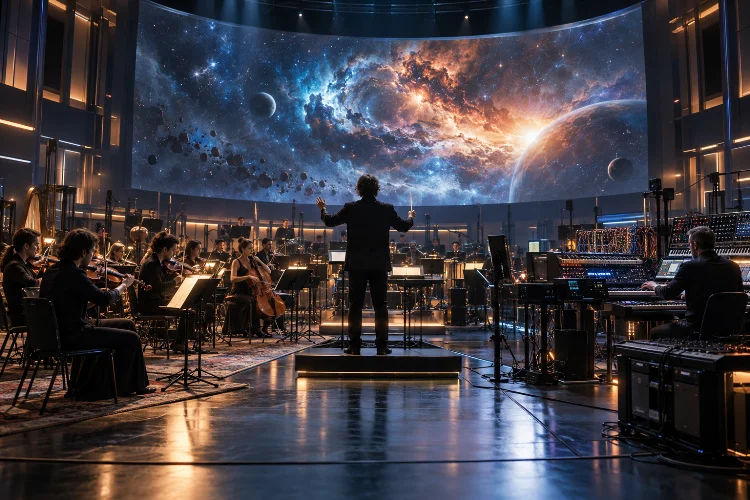
Imagine watching a spaceship drift through an endless galaxy while a powerful orchestra swells beneath a mysterious electronic pulse. The strings create a sense of wonder, the synthesizers suggest advanced technology, and strange processed sounds make the environment feel unfamiliar.
Suddenly, the fictional universe seems enormous, emotional, and surprisingly believable.
That’s the magic of orchestral hybrid scoring.
Modern science fiction films often explore extraordinary environments, futuristic technologies, and unfamiliar forms of intelligence.
Traditional orchestral music can communicate powerful human emotions, but electronic instruments offer additional possibilities for creating sounds that feel unusual or otherworldly.
Combining these approaches allows composers to establish distinctive musical identities that support both spectacle and character development.
Exploring orchestral hybrid scoring in modern science fiction films reveals how composers balance acoustic performances, digital synthesis, experimental sound design, and cinematic storytelling.
From Hans Zimmer’s monumental music in Interstellar and Dune to Daft Punk’s electronic-orchestral compositions for Tron: Legacy, hybrid soundtracks have become an important part of contemporary filmmaking.
Let’s explore the techniques behind these scores, examine influential examples, and discover how composers create musical worlds that feel both futuristic and emotionally human.
What Is Orchestral Hybrid Scoring in Film Music?
Orchestral hybrid scoring combines traditional orchestral instruments with electronic music production, synthesized sounds, sampling, and other contemporary audio techniques.
A typical hybrid soundtrack might include live strings, brass, woodwinds, electronic bass, synthesizer pads, processed percussion, and digitally manipulated recordings.
The purpose isn’t simply to make orchestral music louder or more technologically impressive.
Instead, composers use different sound sources to communicate contrasting emotional and narrative ideas.
Traditional Orchestral Scoring Versus Hybrid Composition
Traditional orchestral film scoring generally relies on instruments associated with symphony orchestras.
Strings can communicate warmth or vulnerability, brass can suggest power, and woodwinds often provide delicate melodic colors.
Electronic instruments introduce additional possibilities.
Synthesizers can produce sustained textures, unusual harmonic combinations, distorted rhythms, and sounds without obvious acoustic equivalents.
Hybrid composition combines these musical languages.
A composer might introduce a theme through a solo cello, expand it with synthesized layers, and eventually present it through a full orchestra.
The melody remains recognizable while its emotional character changes.
Why Science Fiction Benefits From Hybrid Music
Science fiction frequently explores the relationship between humanity and unfamiliar environments.
A futuristic setting might include artificial intelligence, distant planets, advanced machines, or completely different social systems.
Electronic sounds can help establish those unfamiliar surroundings.
Orchestral instruments, meanwhile, provide musical connections to recognizable human emotions.
Combining the two allows composers to contrast technological environments with personal experiences.
A character may travel through an alien landscape, but their grief, hope, and fear remain understandable.
The most effective hybrid scores create unfamiliar worlds without losing the emotional connections that make audiences care.
How Acoustic and Electronic Instruments Work Together
Combining orchestral and electronic elements requires more than layering sounds randomly.
Each instrument occupies a particular frequency range, produces a distinctive texture, and contributes to the overall musical arrangement.
Composers must carefully decide which elements support the melody, harmony, rhythm, and atmosphere.
Strings and Synthesizer Pads
String instruments are particularly flexible because they can produce sustained notes, rapid rhythmic passages, and expressive melodic lines.
Synthesizer pads also create sustained sounds, but their textures can change continuously through electronic modulation.
Combining both elements can produce a rich musical background.
For example, a string section might perform a slowly moving melody while electronic tones establish a spacious, unfamiliar atmosphere.
The resulting sound retains the warmth of acoustic performance while suggesting a futuristic environment.
However, excessive layering can reduce clarity.
A sophisticated arrangement gives different musical elements enough space to remain recognizable.
Brass, Electronic Bass, and Cinematic Scale
Brass instruments can create dramatic musical statements.
Low electronic frequencies can reinforce these moments by adding weight and sustained intensity.
This combination frequently appears in large-scale science fiction action sequences.
However, powerful bass doesn’t automatically create meaningful drama.
Its effectiveness depends on the surrounding musical development.
A quiet passage followed by a sudden orchestral expansion may feel more significant than continuous maximum intensity.
Percussion and Rhythmic Sound Design
Hybrid soundtracks often combine acoustic percussion with electronic rhythms.
Traditional drums provide physical impact, while synthesized pulses can create precise, mechanical movement.
A composer might use repeated electronic patterns to represent machinery or technological processes.
Live percussion can introduce expressive variation and a sense of human performance.
The contrast allows rhythmic music to feel controlled without becoming completely mechanical.
Interstellar and the Emotional Power of Hybrid Scoring
Christopher Nolan’s Interstellar (2014) offers a particularly memorable example of unconventional orchestral composition.
Hans Zimmer’s score combines pipe organ, orchestra, piano, synthesizers, and carefully controlled musical repetition.
Instead of concentrating exclusively on futuristic electronic sounds, Zimmer developed an emotional musical language connected to family relationships and the experience of space exploration.
Why the Pipe Organ Became Central
One of the soundtrack’s defining instruments is the pipe organ.
Zimmer recorded organist Roger Sayer performing at Temple Church in London.
The instrument creates a distinctive combination of sustained harmonic power and physical resonance.
According to Sayer’s account of the production, Zimmer and Nolan selected the church’s organ as a central part of the film’s musical identity.
The instrument feels simultaneously familiar and enormous.
Its sound can suggest spiritual wonder, emotional vulnerability, and the scale of the universe.
Combining Orchestra and Electronics
Although the organ receives considerable attention, the soundtrack also uses orchestral and electronic textures.
Strings and synthesizers support recurring harmonic patterns, while piano passages introduce intimacy.
This contrast helps the music shift between personal relationships and cosmic exploration.
In a scene emphasizing Cooper’s connection with his daughter, restrained musical material can feel deeply emotional.
When similar ideas expand into a larger arrangement, they communicate the extraordinary scale of the journey.
The hybrid approach connects these different experiences through a consistent musical identity.
Why Emotional Simplicity Matters
The most recognizable musical ideas in Interstellar are often relatively simple.
Repeated harmonic patterns develop gradually through changes in texture and intensity.
This allows the music to become increasingly powerful without constantly introducing new melodies.
The soundtrack demonstrates that technological sophistication doesn’t require complicated musical writing.
Sometimes, an expressive acoustic instrument combined with carefully controlled electronic production creates a more memorable result than an elaborate arrangement.
Dune and the Creation of an Alien Musical Language
Denis Villeneuve’s Dune (2021) and Dune: Part Two (2024) present a different approach.
Rather than blending a conventional orchestra with obvious synthesizer sounds, Hans Zimmer and his collaborators developed an extensive collection of unusual musical textures.
Their goal was to create an unfamiliar sonic world appropriate for the fictional universe of Arrakis.
Moving Beyond Conventional Orchestra Sounds
In a detailed Sound on Sound interview published in April 2024, Zimmer described his desire to avoid relying automatically on familiar Western orchestral conventions.
The team experimented with electronic synthesis, processed acoustic instruments, unusual playing techniques, and custom sound creation.
Guitarist Guthrie Govan recorded sustained electric-guitar sounds that could function like an unconventional string section.
Bassist Juan García-Herreros developed experimental bass textures, while cellist Tina Guo contributed electric-cello performances.
These sounds often became difficult to identify as ordinary instruments.
That ambiguity helped establish the film’s unfamiliar musical atmosphere.
Human Voices as Otherworldly Instruments
Vocals play a central role in the Dune soundtracks.
Singer Loire Cotler contributed distinctive vocal techniques, including unusual rhythmic and expressive effects.
These performances can suggest ritual, cultural identity, mystery, and emotional intensity.
Electronic processing expands their sonic possibilities.
Some passages blur the distinction between singing, instrumental music, and abstract sound.
This creates a musical language that feels connected to human expression while resisting familiar expectations.
Custom Instruments and Experimental Synthesis
The second film expanded this approach through specialized instruments and advanced synthesis.
Woodwind performer Pedro Eustache developed a modified chromatic duduk to perform material that exceeded the range of a conventional instrument.
Zimmer’s team also worked with specialists using instruments such as the Expressive E Osmose and Haken Continuum.
These tools allow performers to shape electronic sounds through highly expressive physical gestures.
The result challenges the distinction between acoustic and electronic performance.
A synthesized sound can contain expressive qualities normally associated with an instrumentalist, while a physical instrument can produce textures resembling electronic noise.
Music as Worldbuilding
The most important achievement of Dune‘s soundtracks is their connection to the fictional environment.
The music establishes cultural identities, technological scale, political conflict, and the unforgiving atmosphere of the desert planet.
Its unusual textures aren’t merely decorative.
They become part of how audiences understand the world.
This illustrates one of hybrid scoring’s greatest advantages: composers can create musical environments that feel distinct from everyday reality.
Blade Runner 2049 and the Legacy of Electronic Cinema
Denis Villeneuve’s Blade Runner 2049 (2017) presents a world dominated by artificial intelligence, urban isolation, and questions about human identity.
Its score, composed by Hans Zimmer and Benjamin Wallfisch, builds on the electronic musical traditions established by Vangelis in the original Blade Runner (1982).
However, the newer film also uses acoustic performances and extensive sound processing.
Synthesizers as Emotional Instruments
The soundtrack makes prominent use of synthesizers, including the Yamaha CS-80.
This instrument is closely associated with Vangelis’ original score.
In an interview with FACT, Zimmer and Wallfisch discussed how they used vintage and modern electronic instruments to create expressive textures.
The composers valued the physical responsiveness of older synthesizers.
Rather than treating electronics as purely mechanical devices, they approached them as instruments capable of communicating emotion.
This is particularly appropriate for a film exploring the boundaries between artificial and human experience.
Combining Acoustic Recordings With Digital Processing
The production also incorporated live instrumental performances.
Certain string and double-bass recordings were processed through electronic effects to create unusual textures.
This allowed acoustic sound sources to develop unfamiliar sonic characteristics.
The approach mirrors the film’s central themes.
Sounds begin with recognizable human performances but transform through technological manipulation.
The resulting music can feel simultaneously organic and artificial.
Sound Design and Musical Atmosphere
Blade Runner 2049 also demonstrates the importance of collaboration between composers and sound designers.
Mechanical ambience, electronic drones, environmental noise, and musical textures occupy overlapping sonic spaces.
Sometimes the boundary between the score and the fictional enviroment becomes difficult to identify.
This creates a continuous sense of atmosphere.
Rather than relying on music to interrupt the action, the soundtrack becomes part of the world itself.
Tron: Legacy and the Fusion of Electronic Music With Orchestra
Joseph Kosinski’s Tron: Legacy (2010) offers another influential example of hybrid film scoring.
The soundtrack was created by electronic music duo Daft Punk, working with arranger and orchestrator Joseph Trapanese.
The film’s digital universe provided an obvious opportunity for synthesizer-driven music.
However, the creative team also wanted the emotional scale of traditional cinematic orchestration.
Why Daft Punk Chose a Full Orchestra
Although Daft Punk were famous for electronic dance music, they approached the soundtrack differently from their commercial recordings.
They wanted a sound that could communicate technological futurism while supporting dramatic storytelling.
The production incorporated an 85-piece orchestra recorded at AIR Lyndhurst Studios in London.
According to a Los Angeles Times interview, the team developed extensive electronic sketches and worked with Trapanese to translate their ideas into orchestral arrangements.
The result combines recognizable electronic production with large-scale symphonic writing.
Electronic Rhythms and Emotional Melodies
Tracks such as Derezzed emphasize energetic electronic rhythms.
Other passages, including Adagio for Tron, rely more heavily on orchestral expression.
This contrast reflects the film’s changing dramatic requirements.
Digital action sequences benefit from precise electronic momentum, while emotional scenes can draw on broader harmonic development.
The soundtrack demonstrates that an electronic composer doesn’t need to abandon a recognizable musical identity when working with an orchestra.
Instead, both approaches can contribute to one coherent cinematic language.
Retro-Futurism Through Sound
One of the soundtrack’s most interesting qualities is its combination of older musical traditions with futuristic technology.
Classic orchestral textures coexist with synthesizers associated with decades of electronic music development.
The result feels neither completely modern nor deliberately old-fashioned.
It establishes a distinctive retro-futuristic identity appropriate for the film’s visual world.
This approach illustrates why hybrid scoring can communicate technological themes without relying on unfamiliar sounds exclusively.
Arrival and the Relationship Between Music, Language, and Silence
Denis Villeneuve’s Arrival (2016) takes a more restrained approach to science fiction scoring.
Composer Jóhann Jóhannsson developed a soundtrack combining human voices, instrumental textures, and electronic processing.
The film explores communication with an unfamiliar extraterrestrial intelligence.
Its music reflects this theme by transforming recognizable vocal sounds into strange and emotionally ambiguous expressions.
Human Voices Become Musical Material
Jóhannsson worked with the vocal ensemble Theatre of Voices and performer Robert Aiki Aubrey Lowe.
Their contributions helped establish the film’s distinctive musical atmosphere.
In an interview with The Guardian, Jóhannsson explained that he wanted to use the human voice in an unconventional way because the story centered on language and communication.
The resulting sounds often resemble attempts at expression without clearly recognizable words.
This creates an interesting connection between the soundtrack and the narrative.
The audience hears something that feels meaningful but remains difficult to interpret.
Organic Sounds Meet Electronic Manipulation
The score combines natural vocal performances with experimental musical textures.
Sustained harmonies, unusual vocal techniques, and electronic treatments create an atmosphere that feels simultaneously human and alien.
Unlike more action-oriented science fiction soundtracks, Arrival rarely relies on continuous rhythmic intensity.
Instead, the music develops through gradual changes in texture and emotional color.
This supports the film’s thoughtful exploration of perception, memory, and communication.
Silence Is Part of the Arrangement
One of the most important lessons from Arrival concerns musical restraint.
Jóhannsson emphasized the value of leaving space for silence.
When the score disappears, environmental sounds and dialogue become more significant.
The absence of music can also create uncertainty.
When musical material eventually returns, it often carries greater emotional weight.
This demonstrates that sophisticated hybrid scoring isn’t defined by the number of instruments playing simultaneously.
Knowing when to remove sound can be just as important as knowing when to introduce it.
The Technology Behind Contemporary Hybrid Film Scores
Modern scoring technology gives composers extraordinary flexibility.
Digital audio workstations, sample libraries, virtual instruments, and advanced audio-processing systems make it possible to combine numerous sound sources within a single production.
However, achieving a convincing hybrid soundtrack requires more than owning sophisticated software.
Digital Audio Workstations and Virtual Instruments
A digital audio workstation, or DAW, allows composers to record, edit, arrange, and mix music.
Virtual instruments can reproduce orchestral sounds or generate entirely electronic textures.
Composers often create detailed demonstrations before arranging sessions with live musicians.
This allows directors and editors to evaluate musical ideas while scenes are still changing.
However, sampled instruments don’t always reproduce the expressive flexibility of a live performance.
Professional scores frequently combine virtual instruments with recorded musicians to preserve realism and emotional nuance.
Sampling and Sound Manipulation
Sampling involves recording sounds and using them as musical material.
A composer might record a bowed metal object, manipulate its pitch, and transform it into a sustained atmospheric texture.
Similarly, a cello performance could be processed until it resembles an electronic drone.
These techniques allow ordinary instruments to become unfamiliar sonic resources.
The Dune production demonstrates how extensively this approach can be developed.
Rather than simply imitating orchestral instruments electronically, composers can transform physical performances into sounds that wouldn’t exist naturally.
Effects Processing and Spatial Design
Reverb, delay, distortion, filtering, and granular processing can significantly alter musical textures.
Long reverberation can create the impression of enormous spaces.
Distortion may suggest mechanical instability, while granular processing can break a recorded sound into fragments.
However, excessive processing can make a score difficult to understand.
Every effect should support the emotional or narrative purpose of the scene.
The strongest soundtracks use processing to establish identity rather than merely demonstrate technical complexity.
How Hybrid Scores Influence Emotion and Worldbuilding
Science fiction often contains extraordinary technology, but its stories remain rooted in recognizable human concerns.
Characters experience fear, grief, hope, loneliness, and attachment.
Hybrid scoring helps filmmakers connect these emotional experiences with unfamiliar environments.
Acoustic Instruments Suggest Humanity
Audiences may associate expressive instrumental performances with vulnerability and personal emotion.
A solo violin or piano can introduce intimacy even within a visually overwhelming scene.
This contrast helps make futuristic environments emotionally accessible.
For example, Interstellar uses familiar musical expression to connect cosmic exploration with family relationships.
The large-scale orchestral writing becomes meaningful because it develops from recognizable emotional material.
Electronic Sounds Suggest the Unknown
Synthesized textures can establish uncertainty about the nature of a location, character, or technology.
A sustained electronic drone might communicate vast distance or unfamiliar machinery.
However, electronic sounds aren’t inherently emotionless.
The expressive synthesizer writing in Blade Runner 2049 demonstrates how digital and analog technology can communicate loneliness, longing, and vulnerability.
The distinction between human and technological sounds can therefore become deliberately blurred.
Hybrid Music Supports Narrative Transformation
A film might introduce a character through restrained acoustic music.
As the character encounters unfamiliar technology, electronic elements gradually enter the arrangement.
Later, both musical languages may merge.
This can represent the character’s changing relationship with their surroundings.
The progression provides a musical equivalent of narrative development.
Instead of simply accompanying events, the score helps communicate transformation.
The Challenges of Producing an Effective Hybrid Score
Hybrid scoring offers considerable creative freedom, but it also introduces practical challenges.
Acoustic and electronic elements can compete for the same frequencies.
Complex arrangements may become overwhelming, particularly when a film includes dialogue and elaborate sound effects.
Composers need to manage these competing requirements carefully.
Maintaining Clarity in Dense Arrangements
A large orchestra, powerful synthesizer bass, and extensive percussion can produce an impressive sound.
However, layering everything at maximum intensity often reduces musical definition.
Important melodies may become difficult to hear.
Mixing engineers must balance instruments while preserving the overall emotional impact.
Sometimes the solution involves removing elements rather than adding more.
A simplified arrangement can make a scene feel considerably more powerful.
Keeping the Soundtrack Distinctive
Hybrid scoring has become increasingly familiar in contemporary cinema.
This creates the risk of relying on predictable formulas.
Repeated electronic pulses, enormous bass impacts, and dramatic string crescendos can become generic when used without a clear creative purpose.
Composers should ask what makes a particular fictional universe different.
The unusual instrumental approach of Dune and the vocal experimentation of Arrival demonstrate how distinctive musical identities can emerge from narrative concepts.
Balancing Music and Sound Effects
Science fiction films frequently contain complicated sound environments.
Spaceships, futuristic vehicles, machinery, weapons, and unfamiliar creatures can occupy substantial sonic space.
Music must coexist with these effects.
The sound team behind Blade Runner 2049 discussed how early sound-design work influenced the final integration of the score.
Effective collaboration allows each element to support the scene rather than compete for attention.
The final soundtrack should feel cohesive, even when its individual components were created through very different processes.
How to Analyse Orchestral Hybrid Scoring in Science Fiction Films
Understanding hybrid music becomes easier when listeners focus on the relationship between sound sources and storytelling.
You don’t need professional compositional training to recognize many of these techniques.
Careful listening can reveal why particular scenes feel emotionally powerful or unusually immersive.
Identify Acoustic and Electronic Layers
Begin by listening for recognizable instrumental sounds.
Can you hear strings, brass, piano, percussion, or human voices?
Next, notice the synthesized textures surrounding those instruments.
Do they reinforce the melody, provide rhythmic movement, or establish an unfamiliar atmosphere?
Pay attention to how the different elements interact.
Sometimes electronic sounds remain in the background, while at other moments they become the primary musical voice.
Follow Changes Across the Narrative
Choose a recurring musical idea and notice how it develops.
A melody might begin with an acoustic instrument and later return through synthesizers.
Its rhythm, harmony, and instrumentation may also change.
Consider how these transformations relate to the characters’ experiences.
For example, the gradual expansion of musical textures in Interstellar frequently connects intimate emotions with larger narrative stakes.
Compare Different Approaches
Listening to several soundtracks reveals how flexible hybrid composition can be.
| Film | Composer | Distinctive Scoring Approach |
|---|---|---|
| Interstellar (2014) | Hans Zimmer | Pipe organ, orchestra, piano, and electronics |
| Dune (2021–2024) | Hans Zimmer and collaborators | Processed instruments, experimental synthesis, and vocals |
| Blade Runner 2049 (2017) | Hans Zimmer and Benjamin Wallfisch | Expressive synthesizers, acoustic recordings, and sound processing |
| Tron: Legacy (2010) | Daft Punk, with Joseph Trapanese | Electronic production combined with large-scale orchestration |
| Arrival (2016) | Jóhann Jóhannsson | Experimental vocals, instrumental textures, electronics, and silence |
These films demonstrate that no single instrumentation defines successful hybrid scoring.
The creative approach depends on the story’s emotional and visual identity.
Listen for Musical Restraint
Finally, consider what happens when the music becomes quieter or disappears.
Does the absence of orchestration make an environment feel more mysterious?
Do electronic sounds become more noticeable when acoustic instruments stop?
Does a returning melody feel stronger because the soundtrack previously allowed space?
These questions reveal how composers manage expectation and emotional impact.
Often, the most effective musical choices aren’t the loudest or most technically complicated ones.
The Future of Orchestral Hybrid Scoring
Film-scoring technology continues developing.
New synthesis techniques, expressive controllers, and digital production tools allow composers to explore increasingly unusual musical possibilities.
However, technological progress doesn’t automatically produce better storytelling.
The most important innovations emerge when composers connect creative experimentation with emotional meaning.
Expressive Electronic Instruments
Modern controllers can capture detailed performance gestures.
Instead of simply pressing a key to trigger a fixed sound, musicians can modify pitch, intensity, and timbre through continuous movement.
Instruments such as the Osmose and Continuum demonstrate these possibilities.
Their use in Dune: Part Two illustrates how electronic composition can become increasingly connected to physical expression.
This may further blur the traditional distinction between acoustic performance and digital synthesis.
Personalized Sonic Worlds
Future science fiction productions may develop musical identities using custom instruments, unique recordings, and increasingly flexible processing.
Composers could create entire sound libraries designed around one fictional civilization, environment, or technology.
However, originality requires more than producing strange sounds.
The music must remain connected to the story.
A distinctive sound becomes meaningful when audiences associate it with characters, emotions, or narrative ideas.
Human Creativity Remains Central
Software and artificial intelligence may assist with technical aspects of music production.
However, artistic decisions still determine whether a score communicates effectively.
Choosing when a melody should return, how a texture should evolve, and whether a scene needs music requires thoughtful interpretation.
The future of orchestral hybrid scoring will likely involve increasingly sophisticated tools.
Its lasting value, however, will depend on the same principle that has always shaped memorable film music: emotional storytelling.
Orchestral hybrid scoring has transformed the musical identity of modern science fiction cinema.
By combining acoustic instruments, synthesizers, experimental textures, and advanced sound design, composers create soundtracks that communicate both futuristic environments and recognizable human emotions.
Films such as Interstellar, Dune, Blade Runner 2049, Tron: Legacy, and Arrival demonstrate how different approaches can produce distinctive cinematic experiences.
The strongest hybrid scores don’t merely combine technologies. They use sound to develop characters, establish unfamiliar worlds, and reinforce important narrative ideas.
As musical tools continue evolving, composers will gain even more opportunities to experiment with the relationship between human performance and electronic expression.
Next time you watch a science fiction film, listen closely to how its acoustic and electronic elements interact.
You may discover that the soundtrack is building an entire universe alongside the images.