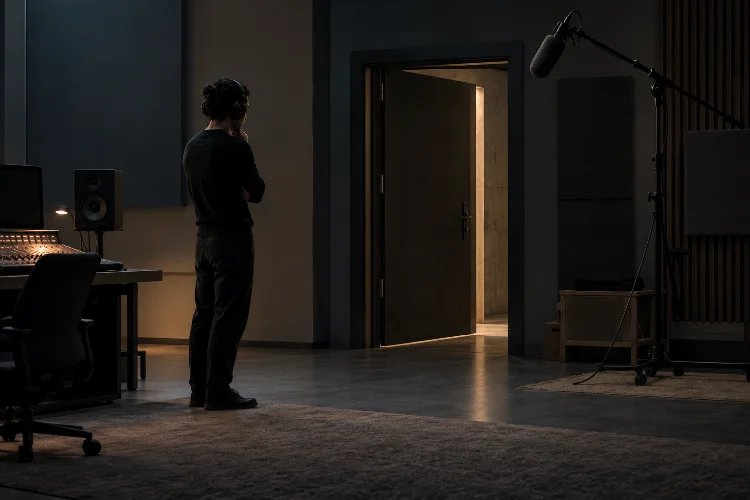
Imagine watching a thriller where a character slowly opens a mysterious door. The music suddenly stops, background noises disappear, and everything becomes unnaturally quiet. Nothing frightening has happened yet, but your heartbeat seems louder than ever.
Why does that silence feel so powerful?
In cinema, sound is often associated with dialogue, music, explosions, footsteps, and atmospheric effects. However, some of the most memorable cinematic moments happen when filmmakers deliberately remove or reduce those sounds.
Silence can create suspense, communicate grief, emphasize isolation, and encourage audiences to notice details they might otherwise ignore.
Understanding silence as a dramatic device in film sound design reveals how filmmakers transform the absence of sound into an expressive storytelling technique.
From the carefully controlled quietness of A Quiet Place to the unsettling sonic environment of The Zone of Interest, silence can shape emotional experiences just as effectively as a powerful orchestral soundtrack.
But cinematic silence isn’t always completely silent. It often involves subtle ambience, carefully balanced frequencies, and strategic sound removal.
Let’s explore how this technique works, why it affects audiences, and how filmmakers use it to create unforgettable dramatic moments.
What Does Silence Actually Mean in Film Sound Design?
Silence in cinema rarely means the complete absence of every audible sound.
Most films contain several layers of audio, including dialogue, music, environmental ambience, Foley effects, and designed sound textures.
When filmmakers create a silent moment, they often remove selected layers while preserving others.
This produces a controlled listening experience rather than an entirely empty soundtrack.
Absolute Silence Versus Relative Silence
Absolute silence refers to the absence of audible sound.
Relative silence occurs when a scene becomes noticeably quieter compared with its surrounding moments.
For example, a crowded restaurant scene might contain conversations, background music, dishes, and movement.
If the soundtrack suddenly removes those sounds and leaves only a character’s breathing, the moment may feel almost completely silent.
Technically, sound remains present.
Dramatically, however, the contrast creates a powerful impression of isolation.
Silence Is a Creative Decision
A quiet scene isn’t automatically meaningful.
Its emotional effect depends on timing, context, and the audience’s expectations.
Consider a peaceful landscape accompanied by soft wind.
The atmosphere might feel relaxing.
Now imagine the same landscape immediately after a frightening event.
The quietness could suggest uncertainty or emotional shock.
The difference comes from narrative context.
Sound designers therefore treat silence as something that must be shaped carefully rather than simply leaving an audio track empty.
The Importance of Room Tone
Room tone is the subtle ambient sound naturally present in an environment.
It might include ventilation, distant traffic, electrical hum, or barely noticeable environmental noise.
Sound editors often use room tone to maintain continuity between dialogue recordings.
However, it can also contribute to dramatic silence.
A faint background hum may make an otherwise quiet scene feel realistic.
Removing that hum can create a more unnatural sensation.
The choice depends on whether the filmmaker wants the environment to feel familiar, empty, or psychologically unsettling.
How Silence Creates Suspense and Psychological Tension
Suspense develops when audiences anticipate an important event without knowing exactly when or how it will occur.
Music and sound effects can communicate danger directly.
Silence creates a different experience.
It removes familiar emotional guidance and encourages viewers to pay closer attention.
Why Quiet Moments Increase Anticipation
Imagine a character searching an abandoned house.
A dramatic soundtrack might immediately tell audiences that danger is approaching.
Without music, viewers may become more attentive to ordinary sounds.
A floorboard creaks.
A door moves slightly.
A distant object falls.
Each sound becomes potentially significant.
The quietness encourages audiences to search for information.
This makes silence particularly useful in psychological thrillers and horror films.
The Relationship Between Silence and Uncertainty
Human perception relies partly on predicting what might happen next.
When a film establishes an expected sound pattern, interrupting that pattern can attract attention.
For example, a mechanical hum might continue throughout a scene.
If it suddenly disappears, viewers may suspect that something has changed.
The disappearance itself becomes an event.
Silence can therefore suggest danger without showing anything threatening.
However, this response isn’t automatic.
Its effectiveness depends on how the film establishes expectations beforehand.
Building Tension Through Delayed Sound
A filmmaker may deliberately extend a quiet moment before introducing an important sound.
The longer the delay, the more audiences may anticipate an interruption.
This technique is common in suspense sequences.
However, excessive repetition can make the approach predictable.
If every quiet scene ends with a loud shock, viewers eventually learn the formula.
More sophisticated sound design varies the outcome.
Sometimes, the expected frightening sound never arrives.
The unresolved anticipation can be more disturbing than a conventional jump scare.
A Quiet Place: When Silence Becomes a Narrative Rule
John Krasinski’s A Quiet Place (2018) provides one of the clearest modern examples of silence functioning as a central storytelling mechanism.
The film follows a family attempting to survive in a world inhabited by creatures that hunt through sound.
Making noise can have deadly consequences.
This premise transforms ordinary everyday activities into suspenseful situations.
Sound Becomes a Matter of Survival
In many horror films, characters are frightened by sounds.
In A Quiet Place, the characters are frightened of producing them.
Walking, eating, opening doors, and communicating require careful attention.
The audience quickly learns the same rules.
A small noise that would normally seem harmless becomes potentially catastrophic.
This creates a strong connection between the characters’ behavior and the audience’s listening experience.
The film doesn’t need constant music to explain the danger.
The narrative itself makes every audible detail important.
Subjective Sound and Regan’s Perspective
One of the film’s most distinctive techniques involves representing the hearing experience of Regan Abbott, a deaf character played by Millicent Simmonds.
The sound design periodically shifts toward her perspective.
At certain moments, environmental sounds become dramatically reduced or disappear.
These transitions distinguish her experience from that of hearing characters.
Sound designers Erik Aadahl and Ethan Van der Ryn discussed this approach in interviews about the production.
They described how the film uses contrasting sound perspectives to establish emotional connections and support its suspense.
Why the Quietness Feels So Intense
The film establishes a consistent relationship between sound and danger.
Audiences understand that even small noises can attract the creatures.
As a result, relatively ordinary actions become dramatic events.
The sound design also makes sudden noises feel more intense because they contrast with extended quiet passages.
This demonstrates a fundamental principle of cinematic sound.
The emotional impact of a sound depends partly on what audiences hear immediately before it.
Silence as a Tool for Expressing Character Psychology
Silence doesn’t always communicate external danger.
It can also represent internal emotions.
Grief, loneliness, emotional numbness, confusion, and psychological shock may be difficult to express through dialogue alone.
Reducing sound can help filmmakers represent those experiences.
Emotional Isolation Through Reduced Ambience
Imagine a character receiving devastating news in a busy public location.
The surrounding environment might contain traffic, conversation, and movement.
If those sounds gradually fade, the scene can suggest that the character is becoming disconnected from the world.
The environment remains visually active.
However, the soundtrack reflects the character’s internal experience rather than ordinary physical reality.
This technique can make emotional shock feel immediate.
Instead of explaining the character’s thoughts, the film changes the audience’s perception.
Silence After Traumatic Events
Films sometimes reduce or temporarily remove sound following explosions, accidents, or violent incidents.
The technique may represent disorientation or a character’s altered hearing.
A high-pitched tone might remain while other frequencies disappear.
However, this effect should not be confused with realistic silence.
It is a stylized representation of sensory disruption.
When used carefully, the technique helps audiences experience the character’s confusion.
When overused, it can become a familiar visual-and-audio cliché.
Silence and Unspoken Relationships
Quietness can also communicate emotional distance between characters.
A long pause during a conversation might suggest resentment, hesitation, or unresolved conflict.
The absence of dialogue becomes meaningful because viewers recognize that something remains unsaid.
Sound design can strengthen this effect by allowing subtle environmental details to remain audible.
A ticking clock or distant passing vehicle may emphasize the uncomfortable pause.
The scene becomes dramatic without requiring a musical cue.
Sound Perspective and the Difference Between Hearing and Listening
Film sound design can represent different points of view.
A scene may present sound from an objective perspective, suggesting what exists in the physical environment.
Alternatively, it may adopt a subjective perspective reflecting a particular character’s perception.
Silence can help establish these differences.
Objective Sound Versus Subjective Sound
Objective sound generally presents the surrounding environment without strongly emphasizing one character’s personal experience.
Subjective sound changes the soundtrack according to what a character hears or psychologically experiences.
For example, a busy street might suddenly become quiet when the camera moves into a character’s close-up.
The transition can suggest that the person is concentrating intensely or withdrawing emotionally.
This technique is especially useful when the film explores perception, memory, or psychological instability.
Listening Becomes Part of the Story
Some films encourage audiences to listen actively rather than simply receive audio information.
A character might pause because they hear something unusual.
The soundtrack then reduces competing noises.
Viewers begin searching for the same sound.
This creates a shared experience between the audience and the character.
The effect can strengthen suspense because both are attempting to interpret incomplete information.
Why Small Sounds Become Important
In a densely layered soundtrack, minor environmental sounds may receive little attention.
When most audio layers disappear, those details become prominent.
Breathing, fabric movement, footsteps, and distant machinery can acquire dramatic significance.
The audience begins interpreting ordinary noises as possible narrative clues.
This is why quiet scenes often require extremely detailed sound editing.
The apparent simplicity of the soundtrack may conceal a great deal of creative work.
The Zone of Interest and the Power of Offscreen Sound
Jonathan Glazer’s The Zone of Interest (2023) demonstrates a particularly disturbing relationship between visible domestic life and sounds originating beyond the frame.
The film depicts the family of Auschwitz commandant Rudolf Höss living beside the concentration camp.
Much of the violence remains outside the visible domestic environment.
However, the soundtrack continually reminds audiences of the atrocities occurring nearby.
Sound Creates a Second Narrative
Sound designer Johnnie Burn described the film as having two interconnected stories.
One exists in the visible domestic environment.
The other emerges through the soundscape.
Distant machinery, voices, and other disturbing noises communicate what the characters’ surroundings conceal visually.
This creates a profound emotional contradiction.
The family continues ordinary activities while the soundtrack reveals the reality beyond their garden walls.
The film’s disturbing effect depends not on absolute silence but on the contrast between restrained domestic presentation and persistent offscreen sound.
Why Musical Restraint Matters
Mica Levi composed music for the film, including its ominous opening and closing passages.
However, much of the narrative avoids conventional dramatic scoring.
The absence of continuous music prevents the soundtrack from telling audiences exactly how to respond.
Instead, viewers must confront the relationship between the visible environment and the sounds beyond it.
This approach demonstrates how withholding music can be an ethical and aesthetic decision.
The film doesn’t use musical intensity to simplify the emotional experience.
It allows disturbing sonic details to remain present without conventional dramatic explanation.
Silence Can Reveal Complicity
The characters’ apparent indifference creates a different kind of quietness.
Their domestic conversations and routines continue despite the surrounding atrocities.
The resulting contrast can make ordinary behavior feel deeply unsettling.
The soundtrack exposes the difference between what the characters acknowledge and what audiences understand.
This is a powerful example of sound design communicating meaning beyond dialogue.
It also demonstrates why cinematic silence should be understood as selective emphasis rather than the complete absence of audio.
No Country for Old Men and the Absence of Conventional Film Music
Joel and Ethan Coen’s No Country for Old Men (2007) is frequently discussed for its restrained use of music.
Composer Carter Burwell created a score that is unusually sparse compared with conventional Hollywood thrillers.
The film relies heavily on environmental sound, dialogue, and carefully controlled quietness.
Suspense Without Constant Musical Guidance
Many thrillers use orchestral cues to signal danger.
No Country for Old Men often avoids this approach.
Instead, scenes unfold through footsteps, breathing, movement, and the sounds of physical objects.
The audience must interpret the situation without constant musical instructions.
This creates a distinctive sense of realism and uncertainty.
Violence can occur suddenly without a dramatic musical announcement.
The result feels less predictable than a conventional suspense sequence.
Everyday Sounds Become Threatening
The film’s quiet passages emphasize small acoustic details.
A door opening, a weapon being prepared, or footsteps approaching can become important dramatic events.
Because the soundtrack is relatively restrained, these sounds attract attention.
The audience learns to recognize potential danger through environmental information.
This technique allows suspense to emerge from the characters’ actions rather than from continuous musical escalation.
Silence and Moral Ambiguity
The film also explores violence, chance, and moral uncertainty.
Its restrained soundtrack supports this atmosphere.
Without conventional emotional scoring, audiences receive less guidance about how to interpret particular events.
The quietness can make the film feel emotionally detached.
However, that detachment is part of its dramatic identity.
The absence of familiar musical cues reinforces a world in which violence doesn’t always arrive with warning or explanation.
How Silence Works With Editing and Cinematography
Silence becomes particularly effective when coordinated with visual storytelling.
Editors, cinematographers, directors, and sound designers collaborate to determine how long quiet moments last and what audiences see during them.
The relationship between sound and image shapes the dramatic effect.
Long Takes and Sustained Quietness
A long take allows a scene to unfold without frequent cuts.
When combined with restrained sound, it can encourage audiences to examine the environment carefully.
Viewers may become increasingly aware of subtle movements.
A character standing motionless in a hallway can become unsettling if the shot continues longer than expected.
The lack of musical change may intensify that discomfort.
However, long takes don’t automatically create suspense.
Their effectiveness depends on the narrative stakes and the audience’s expectations.
Close-Ups and Emotional Silence
A close-up directs attention toward a character’s facial expression.
Removing background music can make small movements feel more significant.
A slight change in breathing or expression may communicate emotional conflict.
The technique allows actors’ performances to carry the scene.
Rather than reinforcing every feeling with music, the filmmaker creates room for ambiguity.
This can make emotional moments feel more intimate.
Abrupt Sound Cuts
Editors sometimes remove sound suddenly at a significant dramatic moment.
For example, a loud action sequence might cut directly to a nearly silent room.
The contrast creates a sense of disorientation.
It can also mark a transition between emotional states or narrative environments.
Abrupt sound cuts are particularly effective when they interrupt an established pattern.
However, excessive use can make the technique feel predictable.
Careful timing remains essential.
The Technical Craft Behind Cinematic Silence
Creating convincing silence requires substantial technical control.
Sound designers work with dialogue recordings, ambience, Foley effects, music, and dynamic range.
Even a scene that appears almost completely silent may contain several carefully balanced audio layers.
Noise Floors and Background Ambience
Every recording environment contains some level of background noise.
This is often called the noise floor.
In film production, sound editors may reduce unwanted noise while preserving enough ambience to maintain realism.
Removing every trace of environmental sound can make a scene feel unnatural.
Sometimes, that unnatural quality is intentional.
In other situations, it can distract audiences from the story.
The sound team must decide which approach supports the scene.
Dynamic Range and Contrast
Dynamic range describes the difference between quieter and louder sound levels.
A soundtrack with meaningful dynamic variation can make quiet passages more noticeable.
For example, a sudden reduction in volume after an intense action sequence may create emotional relief or uncertainty.
However, extremely wide dynamic range can create practical listening difficulties.
Viewers using televisions, headphones, or mobile devices may experience the soundtrack differently.
Professional mixing therefore balances artistic intention with playback conditions.
Foley and Micro-Sounds
Foley artists recreate everyday sounds such as footsteps, clothing movement, and object handling.
These recordings can become particularly important during quiet scenes.
A subtle fabric movement may help establish a character’s physical presence.
A carefully recorded footstep can communicate hesitation or urgency.
In a restrained soundtrack, small sounds require precise timing and appropriate volume.
The audience may barely notice them consciously.
Nevertheless, they contribute to the scene’s emotional credibility.
Sound Editing Versus Sound Mixing
Sound editing involves selecting, creating, arranging, and refining audio elements.
Sound mixing combines those elements into the final soundtrack.
Both processes influence cinematic silence.
An editor might decide which ambient sounds remain during a quiet scene.
The mixer then determines how prominently those sounds appear.
A convincing moment of silence often emerges from collaboration between both disciplines.
Silence in Horror, Drama, and Science Fiction
Different film genres use silence for different narrative purposes.
In horror, quietness often creates anticipation.
In drama, it may communicate emotional distance or vulnerability.
Science fiction can use reduced sound to represent unfamiliar environments or altered perception.
Horror: Anticipating the Unknown
Horror films frequently establish threatening sound patterns.
Silence interrupts those patterns and encourages audiences to anticipate danger.
The technique is particularly effective when viewers understand the consequences of making noise.
A Quiet Place builds its entire dramatic structure around this principle.
However, horror filmmakers must avoid relying exclusively on sudden loud interruptions.
Sustained uncertainty can be more psychologically effective than repeated jump scares.
Drama: Making Room for Emotion
Dramatic films often use silence to emphasize personal experiences.
A quiet conversation can reveal tension between characters.
A scene without music may allow grief to emerge naturally through performance.
The absence of musical guidance can also preserve emotional ambiguity.
Audiences are encouraged to interpret what they see rather than receive a predetermined emotional response.
This approach can make character-driven storytelling feel more authentic.
Science Fiction: Representing Unfamiliar Experience
Science fiction sometimes uses silence to emphasize isolation, scale, or unfamiliar physical environments.
Space settings provide an obvious example.
Because sound requires a medium to travel, ordinary sound waves cannot propagate through the vacuum of space.
Filmmakers may use this physical reality to create striking contrasts between interior spacecraft sounds and exterior views.
However, science fiction also frequently uses stylized audio for dramatic purposes.
The decision depends on whether realism or expressive storytelling takes priority.
Why Silence Can Be More Powerful Than Music
Music is an effective tool for guiding emotion.
However, continuous scoring can sometimes reduce a scene’s ambiguity.
Silence offers filmmakers an alternative.
It allows viewers to experience uncertainty without immediately receiving an emotional interpretation.
Silence Encourages Active Interpretation
A dramatic musical cue can suggest sadness, danger, or triumph.
When that cue disappears, audiences may need to interpret the scene more independently.
They become more attentive to facial expressions, environmental details, and narrative context.
This doesn’t mean silence is always superior to music.
Both approaches have important functions.
The strongest films understand when each is appropriate.
Silence Creates Contrast
A quiet passage becomes particularly meaningful when surrounded by intense sound.
Similarly, a loud musical moment may feel more powerful after an extended period of restraint.
This relationship is fundamental to sound design.
Without variation, audiences can become accustomed to constant intensity.
Contrast restores emotional impact.
The goal isn’t to maximize volume or silence.
It’s to shape the audience’s experience through deliberate changes in sound.
Silence Can Make Moments Feel More Real
Everyday life doesn’t contain a continuous orchestral soundtrack.
Removing music can make cinematic situations feel closer to ordinary experience.
This can be particularly effective during intimate conversations or emotionally difficult events.
However, complete realism isn’t always the objective.
Some filmmakers deliberately create unnatural silence to represent psychological experiences.
The effectiveness of the technique depends on its relationship to the story.
How to Analyse Silence in Film Sound Design
Understanding cinematic silence becomes easier when viewers listen carefully to the soundtrack’s structure.
Rather than simply identifying quiet scenes, consider what sounds have been removed and which remain.
These details reveal how filmmakers direct attention.
Identify the Missing Sound Layers
Start by asking whether music, dialogue, ambience, or sound effects have disappeared.
A scene without music may still contain extensive environmental sound.
A scene with almost no ambience may feel considerably more artificial.
Recognizing these differences helps explain the dramatic effect.
Examine the Narrative Context
Consider what happens immediately before the quiet moment.
Has the character experienced something traumatic?
Is danger approaching?
Has an important relationship changed?
Silence becomes meaningful through its relationship with surrounding events.
A quiet scene after a major confrontation may communicate emotional exhaustion.
The same technique before a confrontation might suggest anticipation.
Notice the First Sound That Returns
The return of sound can be as important as its disappearance.
A single footstep might interrupt a prolonged quiet passage.
A distant voice could reveal that another character is present.
An orchestral cue might finally provide emotional resolution.
Pay attention to which sound returns first and why.
That choice often indicates what the filmmaker wants audiences to notice.
Compare Different Films
Watching A Quiet Place, No Country for Old Men, and The Zone of Interest provides a useful comparison.
Each film uses restraint differently.
A Quiet Place makes sound a direct survival threat.
No Country for Old Men reduces conventional musical guidance to support uncertainty and realism.
The Zone of Interest uses restrained scoring and disturbing offscreen sound to communicate a reality beyond the visible domestic setting.
These differences demonstrate the flexiblity of silence as a dramatic technique.
Common Mistakes When Using Silence in Film
Silence can be powerful, but it isn’t automatically effective.
Poorly timed quietness may slow the narrative without creating meaningful tension.
Sound designers must understand the purpose of each silent passage.
Confusing Silence With Empty Sound Design
Removing all sound layers doesn’t necessarily create a compelling moment.
Without appropriate context, the scene may simply feel unfinished.
Effective silence usually involves deliberate decisions about ambience, timing, and emotional perspective.
Even subtle background sounds can contribute to the intended atmosphere.
Overusing the Same Suspense Formula
Repeatedly following silence with sudden loud noises can become predictable.
Audiences may begin anticipating the jump scare rather than experiencing genuine uncertainty.
Variation helps preserve tension.
Sometimes the quiet moment should end gently.
At other times, it might continue without resolution.
The strongest sound design avoids turning every silent passage into the same dramatic trick.
Ignoring Audience Listening Conditions
A quiet scene may sound excellent in a professionally calibrated cinema.
However, audiences also watch films on televisions, laptops, and mobile devices.
Extremely subtle sounds can disappear in noisy environments.
Mixing engineers must consider these differences.
The challenge is preserving artistic intention while maintaining intelligibility across playback systems.
Good silence should feel intentional rather than technically broken.
Silence is one of the most versatile dramatic tools in film sound design.
By reducing music, dialogue, ambience, or environmental noise, filmmakers can create suspense, reveal psychological states, strengthen emotional performances, and direct attention toward meaningful details.
Films such as A Quiet Place, No Country for Old Men, and The Zone of Interest demonstrate how different approaches to quietness can produce completely different cinematic experiences.
Importantly, effective silence rarely means doing nothing. It requires careful editing, precise mixing, and a clear understanding of narrative context.
The most powerful quiet moments often depend on the sounds that came before them and those that eventually return.
Next time you watch a film, pay attention when the soundtrack suddenly becomes quiet.
You might discover that the absence of sound is communicating something more powerful than dialogue or music ever could.